
Purposeful Discomfort and Mental Resilience
Purposeful discomfort, the kind you choose on purpose, builds a different kind of confidence than comfort ever will. That is the idea behind everything Let’s Fuel Growth runs, from the MN Mile to Everest Base Camp training, and it is backed by more than intuition: people who regularly do hard physical things report measurably higher resilience and lower everyday stress.
What Is “Purposeful Discomfort,” Exactly?
Purposeful discomfort is a physical or mental challenge you choose, with a clear reason behind it, rather than a hardship that happens to you. Training for a race, showing up to a cold plunge, pushing through the last mile of a hike you signed up for voluntarily, these are all forms of it. The difference between this and random adversity is agency: you picked the challenge, you can see the reason for it, and you get to feel the result.
THE SHORT VERSION
- Choosing a hard physical challenge builds real, measurable stress tolerance.
- Doing it with other people compounds the benefit far beyond doing it alone.
- The MN Mile and EBC training exist specifically to give people that structured challenge.
Why Doing Hard Things Builds Mental Resilience
Exercise physiologists describe a concept called stress inoculation: controlled exposure to a manageable stressor (a hard run, a cold plunge, an uphill climb) trains your nervous system to recover faster from stress in general, not just physical stress. A person who trains their body to handle discomfort on purpose builds a wider window of tolerance for the unplanned kind of hard day everyone eventually has.
This is not about toughness for its own sake. It is about proving to yourself, repeatedly, that you can start something uncomfortable and finish it. That proof compounds. People who show up for one hard training session are more likely to show up for the next one, and the pattern becomes identity: “I am someone who does hard things,” not just “I did a hard thing once.”
Why Community Changes the Equation
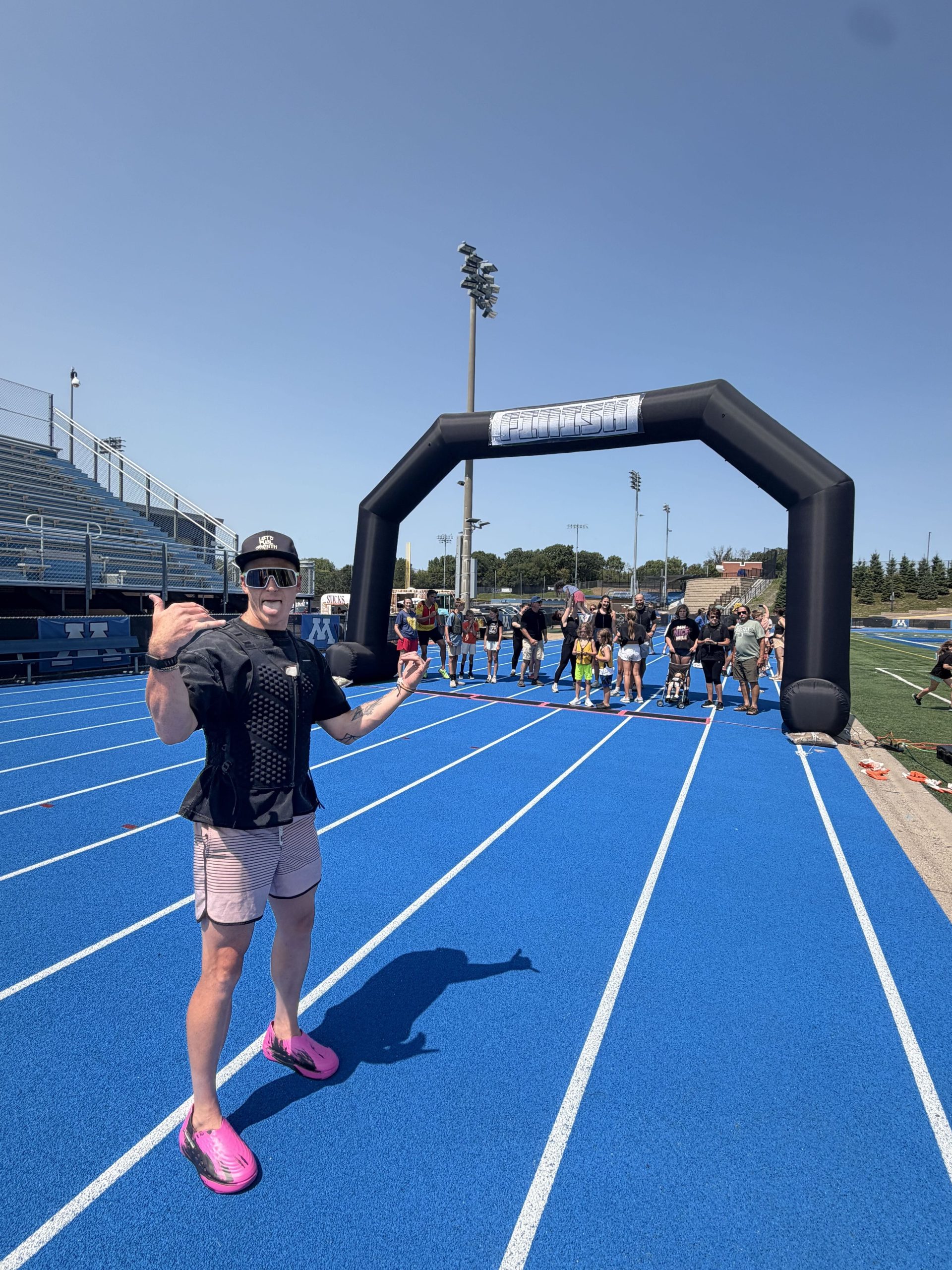
Doing something hard alone builds resilience. Doing it alongside other people builds resilience and belonging at the same time, and belonging is one of the strongest predictors of long-term mental wellness that exists in the research. At Minnetonka High School Track every August, the MN Mile puts people at very different fitness levels on the same starting line, competitive Naughty Mile runners and family-pace Nice Mile walkers alike, because the shared event matters more than the shared pace.
The same principle drives our Everest Base Camp training groups: a cohort that trains together for months before the trip shows up to Nepal already knowing they are not doing this alone. That group bond, built through shared discomfort in training, is frequently the part people remember longest, not the summit view.
How to Build Purposeful Discomfort Into Your Own Routine
| Starting Point | A Purposeful Challenge to Try |
|---|---|
| New to structured exercise | Register for the Nice Mile and commit to a 4-week walk/run training plan with a friend |
| Already active, want more challenge | Train for the Naughty Mile at a pace goal that stretches you |
| Want a bigger, longer-term challenge | Apply for an Everest Base Camp expedition training cohort |
| Want to help without training yourself | Volunteer at an MN Mile aid station or event day crew |
Frequently Asked Questions
Do I need to already be athletic to benefit from purposeful discomfort?
No. The benefit comes from choosing a challenge that is hard relative to where you are starting, not from any absolute fitness level. A first 5K walk carries the same stress-inoculation benefit for a beginner that a technical climb carries for an experienced athlete.
Why does Let’s Fuel Growth focus on events instead of one-on-one coaching?
Group events build the community layer alongside the challenge layer. Training and racing next to other people pursuing the same goal reinforces belonging in a way individual coaching cannot replicate on its own.
What is the difference between the Naughty Mile and the Nice Mile?
The Naughty Mile is the competitive, timed race. The Nice Mile is the family-paced, non-competitive walk or run. Both start and finish at the same event and both count as showing up.
Ready to put this into practice? Register for the MN Mile, or volunteer at the event if racing is not your thing this year. Corporate teams can also reach out about sponsoring or fielding a team.
What the Research Says About Challenge and Connection
A growing body of exercise psychology research links regular voluntary physical challenge to lower reported anxiety and higher self-efficacy, the belief that you are capable of handling what comes at you. Self-efficacy does not stay confined to fitness; someone who proves to themselves they can finish a hard training block tends to carry that same “I can handle this” belief into work stress, family stress, and everyday setbacks. Separately, social connection research consistently ranks belonging to a group with a shared goal among the strongest predictors of sustained wellbeing, ahead of many factors people assume matter more, like income or even physical health status on their own.
Put those two findings together and you get the actual design behind an event like the MN Mile: a physical challenge (the mile itself) wrapped inside a community structure (a shared start line, a shared training season, a shared finish). Neither piece alone does as much as the two together.
Let’s Fuel Growth’s events programming team designs the MN Mile training season, not just race day, around this idea: by the time participants cross the finish line, they have already spent weeks showing up for each other at early training sessions, and that shared preparation is where most of the reported change in confidence and connection happens.
How long does it take to see a mental health benefit from this kind of training?
Many participants report a shift in confidence within the first few weeks of a structured training block, well before event day itself. The consistency of showing up, not the distance covered, is what produces the earliest change.
Can a workplace team join the MN Mile together?
Yes. Corporate teams regularly register as a group, train together ahead of the event, and use it as a team building exercise with a genuine mental health angle rather than a typical office outing.